


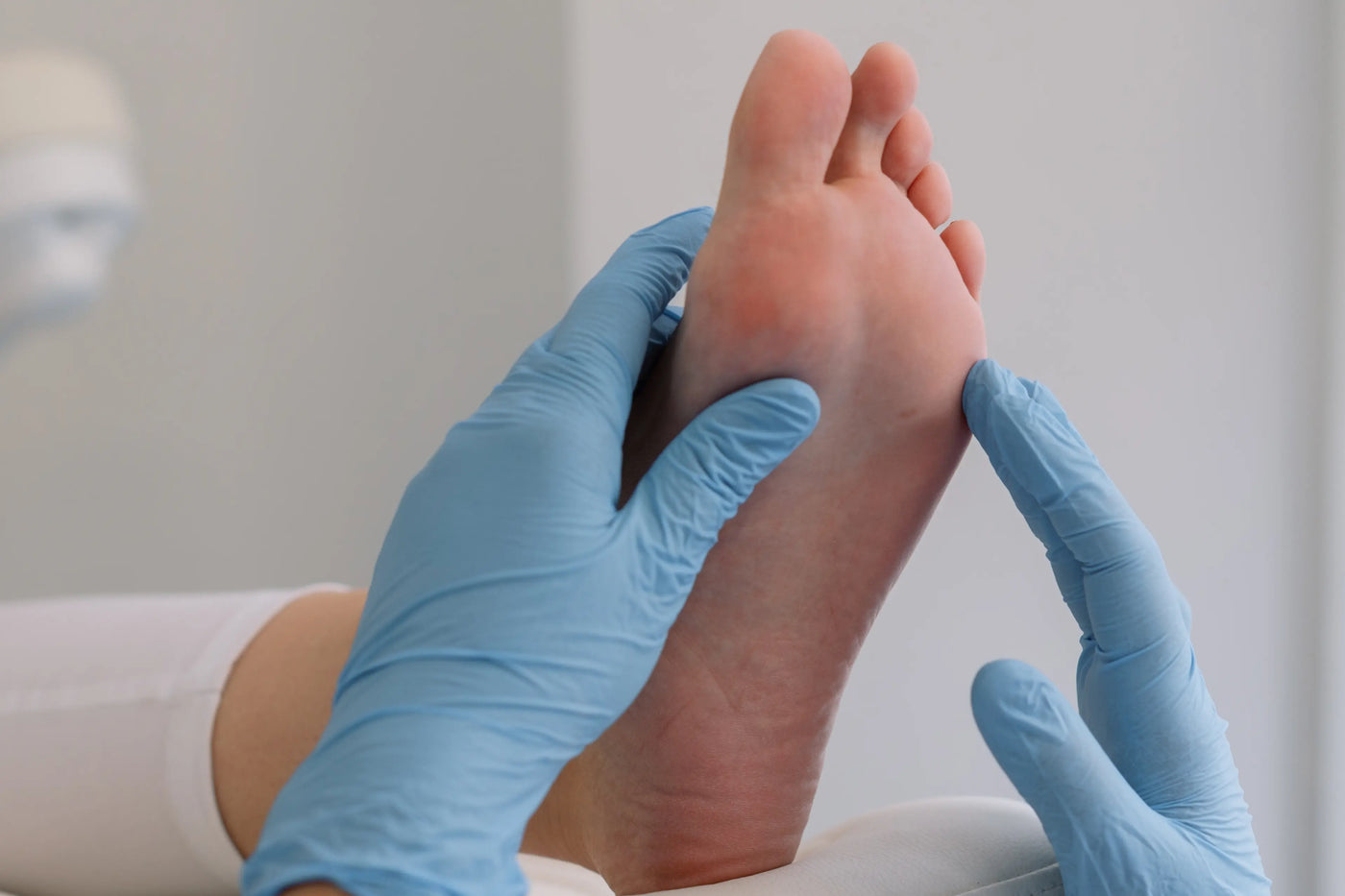
Foot corns: a little annoying, aren’t they? These uninvited guests have a way of making us walk as if we had pebbles in our shoes. Whether you’re looking to prevent corns from forming or treat the ones you already have, discover all our practical tips and tailored solutions for dealing with foot corns.

What is a foot corn?
A corn is a small area of hard, thickened skin that forms a bump on the toes, between the toes, or even on the side of the little toe. It’s also commonly called a “soft corn” or “seed corn” when it appears with a reddish halo and a small black dot in the center — the root of the corn. It is typically cone-shaped and can be painful, often giving the sensation of a thorn embedded in the skin when pressure is applied.
What are the different types of foot corns?
There are several types of foot corns, each presenting slightly differently depending on their location and nature.
- Hard corn is likely the most common. It appears on dry, hard areas of the feet, such as the tops of toes or the soles, forming a compact, painful mass of thickened skin.
- Soft corn tends to form between the toes in moist areas. It is softer in texture but often more painful than hard corns due to the pressure and friction in tight spaces.
- Vascular corns and neurovascular corns are hard corns that contain blood vessels and nerve endings. These types of corns can bleed if cut and are typically more painful than regular corns.
Corns, calluses, hard skin, and warts: what’s the difference?
Unlike a callus, which spreads over a broader area, a corn is more localized. Calluses and hard skin tend to form under the foot or around the heels. A corn can also be mistaken for a wart, but they are not the same. A wart is caused by a virus, not by pressure or friction, and therefore requires a different treatment.

What are the symptoms of a foot corn?
A foot corn is like a painful little reminder that our feet go through a lot of pressure every day! This hardened, well-defined patch of skin forms where there’s the most friction—often on the toes or under the foot. It can be very sensitive, especially when pressed or while walking, and it’s often accompanied by dry, rough skin. If the corn becomes particularly irritated, it can turn red and inflamed due to tight shoes or repeated rubbing.
What causes a foot corn?
A corn can develop for several reasons, but the most common cause is repeated friction inside narrow, stiff, or high-heeled shoes that increase pressure on the forefoot and promote corn formation. In response, the skin thickens gradually to protect itself from the friction—this process is called hyperkeratosis.
Running or walking long distances can also lead to the development of corns.
Likewise, foot deformities such as bunions (hallux valgus), hammer toes, claw toes, or flat feet increase the risk of getting a corn.

How to treat a foot corn?
When a toe becomes painful with redness and calluses appearing, it’s important to protect the area and identify the cause to prevent recurrence.
Toe protectors or digitubes to relieve corns
To quickly ease pain and reduce inflammation on, under, or between the toes, the skin must be shielded from friction. Poderm has developed digitubes to soothe discomfort and stop the formation of corns. These protectors are elastic silicone tubes that slip over the toe. They are lined with Arnica gel, which soothes, repairs, and relieves painful areas. They also help absorb and distribute pressure on the forefoot.
This medical device offers immediate comfort to the toes and fits all types of footwear. Poderm digitubes can be used both preventively and as a treatment.

Corns - Calluses Digitube Protection
Size guides
For guidance

Good to know: Poderm digitubes are washable and reusable.
Plantar corn & soft corn plasters
Plasters for corns or soft corns (commonly known as “eye of the partridge”) also help protect toes from friction and pressure inside shoes. They are usually made with hydrocolloid gel and glycerin, which soothe and hydrate the skin. These plasters should be applied to clean, dry skin and can stay in place for up to 24 hours. It’s best to wait until the plaster naturally detaches before removing it to avoid pain.
What are some home remedies for corns?
Home remedies can help soften corns and reduce inflammation. They’re often used as a first approach when the corn is just starting to form.
Treating a foot corn with white or apple cider vinegar
Vinegar, whether white or apple cider, acts as both an antibacterial and antifungal. Thanks to its acidity, it helps soften the surface of the corn. Always dilute the vinegar to avoid burns—mix one part vinegar with three parts water. Apply the solution directly onto the corn, cover it with a bandage, and leave it overnight. Repeat the process until the corn disappears.
How to treat a foot corn with baking soda
Baking soda has softening properties. You can make a paste with ¼ baking soda and ¾ water. Apply the mixture to the affected area for 30 minutes, then rinse thoroughly.
Green clay for soft corns
Green clay is a well-known natural remedy for corns. It helps relieve inflammation quickly, purifies the area, and softens calluses. Apply as a poultice directly to the corn, cover it with a bandage to prevent the clay from drying out, and leave it on for about 30 minutes before rinsing well.
Removing a corn with lemon
A corn can also be treated naturally with lemon. Lemon is anti-inflammatory, antibacterial, and antimicrobial. When applied directly to the corn, it softens the skin and reduces inflammation. Cut a slice of lemon, place it on the corn, secure it with a bandage, and leave it overnight. Repeat the process until symptoms disappear.
Foot soaks for corns

Removing a foot corn yourself: a good idea?
Removing a foot corn yourself may seem like a quick fix, but it is generally advised to proceed with caution. Corns are caused by a buildup of dead skin in response to pressure or friction, and removing them on your own can sometimes worsen the problem, especially if the method used is incorrect or if hygiene is poor.
There is a risk of injury or infection, particularly for people with poor blood circulation or weakened immune systems, such as diabetics. For these reasons, it is often better to consult a healthcare professional, such as a podiatrist, who can safely and effectively remove the corn and provide personalized advice to prevent it from coming back.
How to remove or treat a foot corn?
Very small corns may disappear quickly if the pressure and friction causing them are removed. However, when treatments are ineffective or the corn is very deep, a foot specialist can remove it. We recommend consulting a podiatrist before attempting any self-treatment to avoid worsening symptoms.
Orthopedic insoles
For some people, corns and “eye of the partridge” (soft corns) reappear regularly even if they wear soft and comfortable shoes. So, how do you get rid of a foot corn? These corns may be caused by foot abnormalities such as hammer toes, claw toes, hallux valgus, or other foot misalignments. If corns persist, a visit to a podiatrist can help identify the cause through a podiatric assessment. Custom orthopedic insoles can be prescribed to correct plantar pressure and thus prevent the corns from returning.
Treatment with salicylic acid and “pommade Cochon”
Most corn removal creams contain salicylic acid and aim to eliminate corns. Salicylic acid can be effective on superficial corns because it only dissolves the skin’s surface, but not the root of the “eye of the partridge.” However, salicylic acid is contraindicated for diabetics.
“Pommade Cochon,” named after the pharmacist who developed it, is a keratolytic medical treatment. Containing 50% salicylic acid, it is recommended as an adjunct treatment for corns, warts, and calluses. Always consult your pharmacist before applying any corn-removal cream containing salicylic acid, and apply it only to the affected area to avoid the risk of burns.
Surgical treatment of “eye of the partridge”
If the corn becomes very painful when walking, a podiatrist can remove it using specialized tools such as a rasp, scalpel, or burr to reduce the corn’s volume. This leads to pain relief by decreasing pressure on the affected area. Depending on the size and depth of the corn, several sessions may be necessary to completely eliminate it.

How to take care of your feet and prevent foot corns?
To keep your feet in great shape and say goodbye to corns, a few simple habits can make all the difference.
First, choose shoes that fit you like a glove—or better yet, like a comfy sock! Avoid models that are too tight or too loose, as these can cause friction and pressure leading to corns. And if you love high heels or pointy shoes, try to alternate with more comfortable footwear from time to time.
Keep your feet clean and dry, especially between the toes, to prevent buildup of hard skin. An occasional relaxing foot soak can also help soften the skin before gently using a pumice stone to remove dead skin without being too harsh.
Moisturize your feet regularly with a good cream to keep the skin soft and prevent thickening. And why not finish with a little foot massage? It stimulates circulation and is a real moment of relaxation for feet that often get forgotten but are so important.
By following these tips, your feet will not only look better but feel more comfortable too. And remember, if a corn becomes stubborn, a visit to the podiatrist can make all the difference—because after all, your feet deserve the best care!


